Opening paragraph
Artificial intelligence is no longer a distant curiosity in the art world. It has become a creative partner that many digital artists welcome and teach with both curiosity and care. At SerinaErFjord.com we explore how AI driven processes intersect with traditional digital practices, evolving the look, pace, and meaning of art. From algorithmic mandalas to generative imagery, AI challenges us to rethink the act of making and the value we attach to human touch. In this article we will map the current landscape, discuss practical tools, address ethical questions, and offer guidance for artists who want to experiment with AI while staying true to their vision.
What AI art is and how it sits within digital art
AI art refers to artwork produced with the help of machine learning models and artificial intelligence techniques. These models learn from vast datasets to generate, transform, or assist in the creation of visual works. In the context of digital art, AI acts as a collaborator that can propose ideas, sharpen techniques, or rapidly iterate designs. The result can be a single image, a sequence of images, or a larger interactive project.
Key ideas to hold in mind
– AI is a tool, not a single solution. It extends human capability rather than replacing it.
– AI art often blends algorithmic patterns with human intent, making authorship more of a cooperative process.
– The aesthetics produced by AI can range from hyper realistic to highly abstract, and often surprise the artist and viewer alike.
– For creators who work in mandalas, typography, or symbolic digital forms, AI can help explore symmetry, color harmony, and meditative geometry at scale.
How AI approaches digital imagery
AI draws on several families of methods, each with its own strengths and quirks:
– Generative models, including diffusion models and generative adversarial networks (GANs), which create new images from learned patterns.
– Image style and transfer algorithms, which apply a particular look or feel from one image to another.
– Text to image systems, which translate written prompts into visual outputs and can be guided by iterative prompts and refinements.
– Image editing and inpainting tools that repair, alter, or complete parts of an image in a stylistically coherent way.
Conscious artists often combine these approaches to suit a project. For example, a digital mandala artist might start with a diffusion based generation to set a core motif and then use style transfer to align the piece with a chosen color palette.
Tools powering AI art today
The field is moving quickly, and the toolkit for AI assisted art is broad. Here are major tool groups artists commonly use in 2026 and beyond.
Generative models
- Diffusion models that iteratively refine random noise into coherent images.
- GANs that generate and evaluate images in a competitive loop to improve realism or abstraction.
- Hybrid models that blend diffusion and GAN elements for specific textures and outcomes.
Style and transformation tools
- Style transfer algorithms that graft the look of one artwork onto another scene.
- Color palette guidance and artistic direction by AI to maintain cohesive series.
- Texture synthesis for surfaces, fabric like patterns, or mandala rings and arcs.
Prompt based and multimodal systems
- Text to image engines that respond to descriptive prompts and constraints.
- Multimodal assistants that interpret prompts in the context of mood boards, symmetry, or cultural references.
- Prompt engineering techniques to coax more precise or surprising results.
Drawing and sketching aids
- AI assisted sketching that completes lines, suggests forms, or enhances perspective.
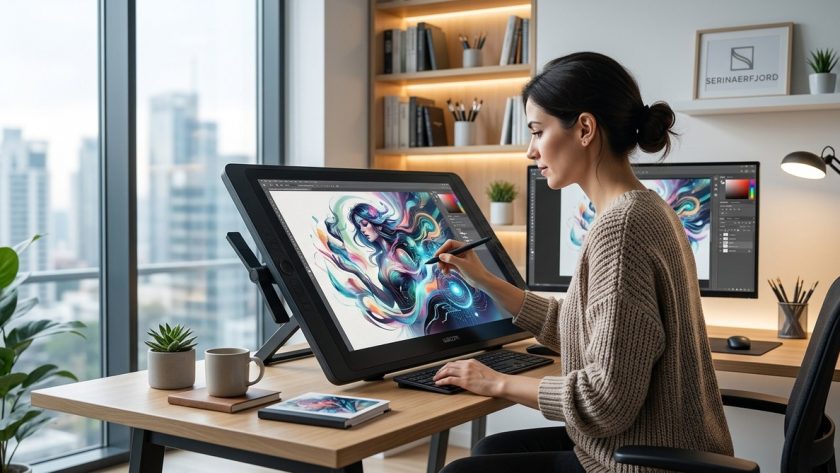
- Line and contour refinement tools for digital drawing tablets and software.
- Auto lay out and grid generation for complex patterns like mandalas.
Image editing and restoration
- AI based upscaling, color correction, and detail enhancement.
- Inpainting and content aware fill for removing or replacing elements in a scene.
- Color harmonization and balance tools that respect a chosen aesthetic.
Data provenance and ethics oriented tools
- Model cards and dataset disclosure features that help artists understand training data and license terms.
- Tools that track edits and enable transparent provenance of AI generated works.
Practical takeaway: Start by identifying a project goal and selecting one or two complementary tools. For a mandala driven digital piece, you might use diffusion to generate motif clusters and a style transfer step to unify color accents across the composition.
The creative process evolving with AI
AI reshapes the workflow of digital artists in both small and large ways. It can speed up routine tasks, unleash novel ideas, and invite new forms of collaboration.
- Accelerated ideation: AI can propose dozens or hundreds of variations in minutes, giving artists a rapid runway to select directions.
- Iterative refinement: By adjusting prompts or constraints, an artist can steer AI outputs toward a desired feel, then fine tune by hand.
- Expanded experimentation: Abstract or surreal results that push beyond manual drafting become more accessible.
- New aesthetics: AI generated textures, light effects, and asymmetries can inspire fresh visual languages.
In practice, many artists treat AI as a co creator. They rely on human sensibility to set aims and values and on AI to offer unexpected pathways. The synergy can yield pieces that feel both intimate and expansive, especially in digital art forms such as mandalas and generative patterns.
The human center in AI art creation
- Intent and context remain the artist’s responsibility.
- Ethical choices around datasets used to train models influence the meaning and reception of work.
- Audience engagement often rises when the artist emerges as the curator of AI outputs rather than simply the operator.
Authorship and originality in AI art
One of the most discussed questions around AI art is who owns the result and who deserves credit. The conversations are ongoing across law, philosophy, and creative communities. Here are some guiding ideas to consider.
- Collaboration rather than substitution: AI can be a collaborator that contributes form, texture, or composition. Your authorship includes your creative direction, editing, and final presentation.
- Documentation matters: Keeping a record of prompts, settings, iterations, and the human decisions behind a piece strengthens transparency.
- Licensing and data provenance: When possible, reference the sources of training materials, or choose models that provide clear licensing terms and attribution options.
- Originality vs reproduction: AI often generates outputs that are unique yet influenced by the training data. Framing your work as a new creation with its own intent helps clarify its value.
- Viewer interpretation: In many digital art contexts, the meaning of the work is enhanced by the artist’s narrative and the way AI is integrated into the process.
Ethical considerations to weigh
– Data consent: Ensure that training data used by AI tools respects creators’ rights and permissions.
– Representation and bias: Be mindful of the biases present in training data and how they might appear in outputs.
– Fair access: Consider the accessibility of AI tools to other artists and communities, avoiding exclusionary practices.
Accessibility and democratization of AI art
AI tools are increasingly accessible, lowering barriers for individuals exploring digital art, mandalas, typography, and experimental visuals. This democratization brings both opportunities and challenges.
- Lower cost of entry: Individuals can experiment with high level outputs without investing in expensive software or hardware.
- Community learning: Online communities share prompts, workflows, and case studies that accelerate skill building.
- Diverse voices: More artists from varied backgrounds can contribute to the digital art landscape when tools are approachable.
- Skill development: While AI handles some technical tasks, mastery of composition, color theory, and storytelling remains essential.
Actions for beginners
– Start with a clear concept or mood and a simple prompt.
– Save and organize a few reliable prompt templates you can reuse with variations.
– Pair AI produced elements with hand crafted textures or line work to preserve a human touch.
– Document your process to build a compelling narrative around your artwork.
Ethical considerations and data concerns
As with any powerful technology, AI art raises questions about ethics and responsibility. Artists who engage with AI should consider both personal ethics and broader implications.
- Data sourcing ethics: Prefer tools and datasets that are transparent about training materials and licensing.
- Accountability: Be clear about how AI contributed to a piece and who curated the final result.
- Cultural sensitivity: Be mindful of cultural symbols and motifs when using AI generated imagery, and avoid misappropriation or harmful representations.
- Environmental impact: Training large models consumes energy; consider the sustainability aspect of your workflow.
SerinaErFjord.com believes thoughtful practice can harmonize innovation with respect for creators, communities, and cultures.
Case studies and examples in contemporary digital art
To illustrate how AI can enrich digital art, consider several common pathways that artists might explore.
- Mandala driven explorations: AI can help generate symmetrical patterns, color harmonies, and layered motifs that form meditative mandalas. The human hand then guides balance, breathing life into the mathematical precision.
- Abstract generative series: An artist might craft a series where AI handles initial motif generation, and the artist handles final color grading, texture, and layering to build a coherent collection.
- Narrative AI art: A digital piece that evolves with interactivity or with a defined storyline can merge AI generated visuals with ambient music or poetry to create a multisensory experience.
- Hybrid photography and AI: Real world imagery can be enhanced with AI to explore surreal or dreamlike states while maintaining a thread of authenticity.
How to structure a case study for a digital art project
– Define the artistic aim: What feeling, concept, or message do you want to express?
– Identify the tools: Which AI models, prompts, or edits will you use?
– Show the process: Include sketches, iterations, and the evolution from concept to final piece.
– Reflect on authorship: Who contributed what, and how does that shape the narrative of the work?
– Share outcomes: Public reception, collaborations, and future directions.
The business side of AI art
AI art presents new opportunities for revenue, licensing, and collaboration in the digital art market.
- Commissioned pieces: Clients may seek AI assisted design for branding, album art, or digital installations.
- Limited editions and prints: High quality prints of AI enhanced works can become collectible items.
- Licensing and usage rights: Clear licensing terms for AI generated imagery help protect both artist and client.
- Educational products and tutorials: Artists can monetize their knowledge by teaching prompt strategies, workflow setups, and ethical practices.
- Digital galleries and marketplaces: Curated AI art shows and online platforms provide visibility and access to a global audience.
Practical tips for monetizing AI art
– Build a cohesive portfolio that highlights your process and your unique human input.
– Be explicit about the role of AI in each piece and the licensing terms.
– Offer behind the scenes content that explains your method and invites viewer interpretation.
– Collaborate with writers, musicians, or researchers to create interdisciplinary works that stand out.
Practical guidance for digital artists and mandala lovers
If you are new to AI art and want to begin a thoughtful, sustainable practice, here are actionable steps.
- Step 1: Define your artistic voice. What themes, colors, or motifs recur in your work?
- Step 2: Choose one or two AI tools that fit your goals. Start with prompts that reflect your concept and build a library of prompts.
- Step 3: Establish a workflow that preserves your hand in the process. Use AI to propose options, then select and refine by hand.
- Step 4: Document your process. Write notes about prompts, settings, and decisions.
- Step 5: Share your work with context. Explain how AI contributed to the piece and what the human artist brought to the final result.
- Step 6: Consider ethical practices. Use tools that respect licensing and provide transparent data provenance.
Practical prompts and workflow ideas
– Prompt discipline: Create a prompt that defines symmetry, color palette, and motif density for a mandala inspired piece.
– Iteration plan: Generate 10 variations, pick 3 favorites, refine each with manual drawing or painting over elements to preserve nuance.
– Style fusion: Combine a traditional mandala motif with a contemporary abstract style to explore tension between order and chaos.
– Color strategy: Use AI to suggest color harmonies tied to a specific mood, then adjust manually for local contrast and balance.
How SerinaErFjord.com fits into this landscape
– The site champions a holistic view of digital art, literary forms, and cultural contexts.
– AI generated art is presented with an emphasis on craft, intention, and the meditative potential of mandalas.
– Readers will find case studies, tutorials, and thoughtful reflections about how technology intersects with artistic practice.
The future outlook for AI in digital art
The trajectory is not about replacing human creativity but expanding it. We can anticipate several trends shaping digital art creation in the coming years.
- Increased collaboration models: Artists will increasingly partner with AI as co creators, editors, and co designers.
- More expressive control tools: Expect interfaces that let artists steer AI outputs with greater precision and nuance.
- Responsible innovation: Ethical guidelines and transparent licensing will become standard practice in professional work.
- Multidisciplinary works: AI art will cross borders into literature, sound, performance, and immersive installations.
- Education and community growth: More programs will teach AI art techniques, expansion of artist led communities, and shared resources.
A closing reflection
AI offers a powerful set of tools that can accelerate exploration, broaden aesthetic possibilities, and cultivate new ways of seeing. Yet the most compelling digital art emerges when the machine serves the artist’s vision rather than dictates it. The future of digital art creation at SerinaErFjord.com embraces thoughtful integration of AI, sustained attention to craft, and a respectful approach to ethics and community.
We invite you to explore AI in your own practice and to share your experiences. How do you balance algorithmic influence with personal touch? Which tools resonate with your mandala making or digital explorations? Join the conversation and help shape a thoughtful path forward for contemporary and digital arts.
Appendix: quick reference checklist for AI art projects
- Define your concept and intended mood before engaging AI tools
- Choose two complementary AI tools that align with your goals
- Create a prompt library and a set of constraints to maintain consistency
- Use AI to generate options, then make final artistic edits by hand
- Document your process and clearly state the role of AI in the work
- Consider licensing, attribution, and data provenance for every piece
- Engage with the community, share both successes and failures, and invite feedback
- Maintain a focus on ethics, sustainability, and cultural sensitivity
SerinaErFjord.com remains committed to exploring digital, literary, and cultural disciplines with care and curiosity. If this topic resonates with you, stay tuned for more articles, tutorials, and thoughtful discussions that bridge technology and art in meaningful ways.